Tuesday, December 17, 2013

Stripped: Against the Over, Under, and Asexualization of Women

 A friend pinned this cartoon via Pinterest today:

 She tagged it with a few things, like 'feminism' and 'oversexualization'. I do not intend to accuse her personally of necessarily thinking any of the following, but the way I took those hashtags in tandem with the picture was that it intended to convey something like this:
"Women/the female body have/has been oversexualized to the point where there are extant double-standards that allow men to dress and behave in ways that are condoned, while women are subject to harsh censure for the same or equivalent behavior and fashions. This is a bad thing."
Now, I understand that there is significant backlash to the modesty-culture rampant in Protestant and some Catholic circles.

Modesty culture places a very heavy onus of responsibility for modesty on women, asserting that it is their appearance and behavior solely that evokes men's lustful responses, and that if men are reacting to them with lust, they must be doing something immodest. Women are expected to be actively modest; men passively so--by not looking or by verbally correcting women in their lives who are not being modest. Advocates of these ideas post vehement articles littered with phrases like 'custody of the eyes' and warn of the beauty of the female body as though it is a detriment, not a God-given reality.  They also claim that women are assigned value as an inverse result of the valuation of modesty, which results in an inadvertent (or, intentional, depending on who you are talking to) devaluation of the woman as a person.

(Disclaimer: This post isn't endorsing the extremes of far-right modesty culture. It's taking issue with the mentality of the above cartoon, that male and female nudity--understanding 'nudity' as nakedness with a sexual connotation--should be defined on a one to one basis in Anglo/American culture).
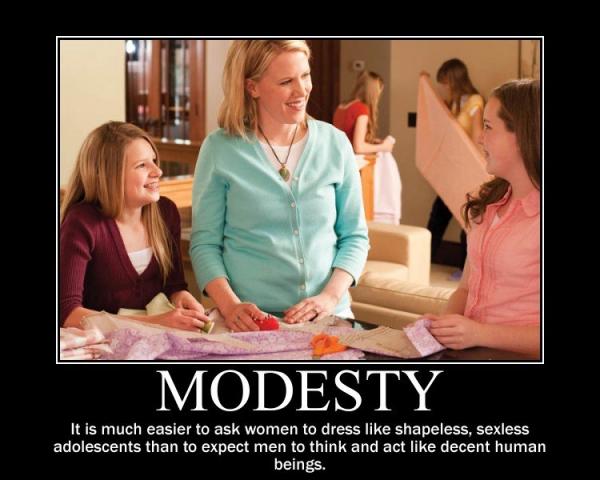

The subsequent push-back against the modesty culture tends towards an opposite extreme.  Even if they are not condoning some kind of orgiastic response to right the injustices inherent in female-based modesty, they usually do call for a great equalizer: the flesh. Women are humans; men are humans. There is nothing innately sexual about the female body, they say, any more than there is about the male body.  All the sexuality associated with the female body is an arbitrary cultural construction.  Any and all exposure shows equality, not indecency. Flesh is flesh.

The seductive danger of the cultural construction model is that it is partially true. In Africa, it is not abnormal or overtly sexual for women to go topless. Indeed, when we see African women on a TV show, or African men in barely-there loincloths, here in the States, we aren't scandalized or incited to lust. It is understood that this is a cultural norm, foreign to ours.  But just because it is cultural does not make it arbitrary.

Furthermore, because our culture does associate sexuality with certain kinds of nakedness (whether or not you condone that), the way in which the counterarguments against modesty culture are phrased cannot be and are not non-sexual.
To uncover, as a woman, cannot be non-sexual in a culture so over-saturated with sex, and with such a historical underpinning of the mystery of the body.
More than that, however, I'm troubled by this apparent desire to erase the feminine qualities which started this whole debate in the first place. Boiling the whole thing down, the argument is over the oversexualization of the female body.  One extreme is the Miley Cyrus-style commodification of the female body.  The other end of the spectrum:  women's bodies should be such neutral territory that they could walk around topless or in revealing clothes and not one man would look at their bodies in a sexual way.  The problems with the former extreme are obvious; the problems with the latter are no less serious, if slightly more subtle.

Doesn't this insistent uncovering, and shrill 'equality'/homogenization do a grave disservice to women? However misguided or over-enthusiastically applied, the modesty culture is a result of a desire to preserve the dignity of women, and prevent them from being completely objectified for their bodies (and for men to be prevented from doing the objectifying).
In response to an oversexualization of women, people on the opposite extreme call for an asexualization--for the removal of the unique and--properly contextualized--beautiful aspects of the feminine form to be neutered as harshly as they accuse shapeless dresses and loose shirts of doing.
On a related level, it's as if proponents of the anti-modesty culture hate the female body and what it means to have one.  The kind of rebellious flaunting of everything without shame, without regard or reverence for the beauty and art of our bodies, as crafted by God, bespeaks a virulent devaluing of them.  You don't burn an effigy because you love the person it represents.  You make a public spectacle or public revelation in this way to bring shame and degradation on the object, or to remove reverence of it.  There is something inculcated in human nature about reverence for the unseen or the hidden, and a perpetual saturation and overexposure not only desensitizes but also debases it.

Finally, to return to the irony.  Part of what is so violent and disfiguring about the act of rape--so often linked with modesty culture as a so-called cause and horrible effect--is that a woman is forcibly uncovered and violated.  Somehow, when such uncovering is voluntary, and the violation is of the eyes and minds of men or children--this is laudable. Did someone mention a double standard?

I'm hardly excusing men from guarding their own purity. Just because a woman decides to walk naked down the street does not mean you have to stare at her and commit mental or actual impurities with her. But--and I've used this analogy before--knowing that we have something so appealing to men, to defiantly shove it in their faces while simultaneously demanding them ignore it is equivalent to knowing your husband is an alcoholic but surrounding him with the smell of alcohol and trying to hold his nose and pour it down his throat, all the while berating him for being tempted to drink.


What I'm getting at is this: if what is truly desired is an equal standard to regulate the relationship between sexuality and the human form, allowing women to go without a shirt because men can is not a solution.  Rather, asking both men and women to cover the sensitive, sexual areas of their bodies out of self-respect and out of respect for the eyes and minds of those around them would be real equality, and would indicate a true understanding of (ungendered) human modesty and sexuality.
Both modesty and sexuality are utterly deplorable influences when decontextualized or homogeneously, disproportionately applied. 
~~~~~~~~~~~~~~~~~~~

Really quickly: I realize I've begun many of my posts with 'I read something a friend posted' or 'On a classmates' facebook'... This is not to say that I'm attacking those friends/coworkers/classmates. One of the primary forces that sparks me to write about a topic is seeing something I strongly agree/disagree with via people I know. So don't take it personally ;)

Friday, December 13, 2013

Rhetorical Questions: In Defense of Pope Francis

I read an article from the Washington Post yesterday called 'Like Pope Francis? You'll love Jesus.' Basically, it's a tongue in cheek notation of the way in which so many left-leaning politicians, celebrities, etc, are all enthused over Pope Francis for what they perceive as a shift in Church policies and attitudes.  The author of the article points out that all Francis is really doing is reiterating ideas that have been innate in the Catholic Church since its founding by Christ.  So, to all those non-Catholics or fallen-away Catholics who are suddenly finding this papacy a reason to be invigorated by their Faith again--this isn't new. Your Faith has always been this invigorating!

I think the article makes an excellent point, and it's nice to see it somewhere like the Washington Post.  More importantly, however, it offers already-faithful Catholics, who probably love Francis because he is renewing and living the tenets of Faith given to us by Christ, some rich food for thought.

Obviously, Catholics aren't out to please the entire world. But there is something to be said for the interest Francis has sparked from so many diametrically-opposed groups.  Nor has he garnered such support by somehow compromising Catholic morality or Catholic teaching.  So what has he done that has suddenly made the Catholic Church and its Faith more palatable to people who wouldn't have touched us with a 15 foot pole before?

First, I think there's something to be said for his demeanor on the most superficial level.

From the very beginning of his papacy, when he stopped by his hotel to pick up his bags personally, or when he called the newspaper vendor from his former diocese, Francis has impressed the world with his affability, his humility, and his humanity.  Not that all our other popes have been stiff or vain--but Francis has such an air of approachability.  We must imagine that Christ had this same air; people from all groups felt able to approach Him without fear of judgment or exclusion, and, upon approaching Him, to feel that He was truly looking at them, listening and speaking to them.  This is the impression people have gotten from Pope Francis.

 
Secondly, it's his method of delivery when speaking, preaching, or writing.  Having fostered with his manner an openness to dialogue in many people who might otherwise have ignored him, he next tends to demonstrate a corresponding gentleness in how he says what he says. That is not to say that he is weak, ambiguous, or abstract (he's been accused of all three).  But everything he says is uttered simply, logically, and charitably.  He sets an example of the things he talks about, especially in regards to love of neighbor, and is so unassuming that you find yourself listening, I think, even when you don't intend to.

But that brings us to the third aspect of Francis' appeal, which is the content of his message. I find it interesting that Francis has been frequently called 'naive', cast by Catholic and secular media alike as though he stumbled into the papacy an inexperienced Diocesan official, and hasn't quite caught the hang of using precise language to express himself on a global scale, or hasn't noticed that what he says off the cuff is broadcasted and can be twisted by the media.

On the contrary, I think Pope Francis is very savvy indeed.  In the new Apostolic Exhortation, Evangelii gaudium (the Joy of the Gospel) he emphasizes the importance of evangelizing the culture on its own terms, not by compromising our values to fit the times, but rather, by speaking a language that the times can comprehend and will gravitate towards.  

It is obvious that he does not have a problem being extremely explicit when he wants to be; take, for example, this quote from the Exhortation: "A preacher who does not prepare is not “spiritual”; he is dishonest and irresponsible with the gifts he has received." (Paragraph 145). He has spoken clearly and firmly on moral issues like abortion, homosexual 'marriage', and the challenges facing the family.  When he talks about female roles in the Church in Evangelii gaudium, he says "The reservation of the priesthood to males, as a sign of Christ the Spouse who gives himself in the Eucharist, is not a question open to discussion" (Paragraph 104). Boom. End of story. Pope Francis is not afraid to be clear, nor is he incapable.

So why is he accused of naivete, or why do left-leaning individuals think, at least at first, that he might be on the brink of an overhaul of Catholic morality?

I see it in terms of a song by M. Ward, one of my favorite artists.  The song "Fisher of Men" says:
"He tied a feather to the hook for to get you to look
And by the time you know what took you, you already took
He's got a line in the water, he's a fisher of men

And he put the thorns on the rose for to get you to bleed
And by the time you know what stuck you, the pain's in deep
He's got a line in the water, he's a fisher of men
He's got a lot on the line, he's a fisher of men"
Similarly, Francis' 'feather on the hook' is his tendency to begin speaking on common, general topic.  He uses the buzzwords to get the attention, like a teaser trailer for a movie, then reiterates the pith of Catholic teaching in a careful, gentle way that highlights its freshness and appropriateness for our time and culture.

For example, let's look briefly (very briefly) at the portion of Evangelii gaudium on multiculturalism.

Francis' method of dealing with this topic is not the accident of an inexperienced Pontiff.  Rather, it is conscious rhetoric.  Aware of "our difficulty in restoring a mystical adherence to the faith in a pluralistic religious landscape" (Paragraph 70), Pope Francis quotes John Paul II in calling for "the faith and the life of the Church [to] be expressed in legitimate forms appropriate for each culture" (Paragraph 118).  He doesn't merely dump this in the middle of the Exhortation, to form an ambiguous glob of multiculturalism that can be applied at the whim of the reader--that would be the result of inexperience or naivete, or even of misdirected good intentions.  Instead, he qualifies his statement with the understanding that cultural diversity must be "properly understood" (Paragraph 117) in order to be useful to the Church's work of evangelization, and develops the idea that "We would not do justice to the logic of the incarnation if we thought of Christianity as monocultural and monotonous" (117).    (This may potentially yield a post soon on the complex issue of Pope Francis and the Extraordinary Form)  This might seem radical, but it is actually only an old tenet of Catholicism phrased anew.

St. Paul puts it this way
“What therefore you unknowingly worship, I proclaim to you," (Acts 17:23)
while Francis says
"As part of his mysterious love for humanity, God furnishes the totality of the faithful with an instinct of faith – sensus fidei – which helps them to discern what is truly of God" (Paragraph 119).
What I'm getting at (without getting further carried away breaking down specifics from the Exhortation) is that Francis is clearly very intelligent, very well educated, and very methodical.  He knows the Truth, he wants to speak the Truth, and he has discerned the best possible way for him to do so in a way that will bear the most fruit in this time and place.  Sometimes his words may come across a little jarring to Catholics--perhaps because we are used to what he would call "fixed formulations learned by heart or by specific words which express an absolutely invariable content" (Paragraph 129), but given the clear and courageous way in which he delineates our morals and tells the world that 'they are not open to discussion', I don't think we need fear (not that we need to anyway, since of course the Holy Spirit protects the Papacy).  Rather, perhaps these jarring moments are an invitation to look closely at what the Pope is saying, and to learn from his example in how he is saying it.
"He's a fisher of men, he's as wise as a prizefighter"


Tuesday, December 3, 2013

Roots, Fruits, and Feminism

Briefly, my thoughts on an article entitled "I'm a Feminist Because I'm Not a Hypocrite."

Laura's post on her blog, Catholic Cravings is about her understanding of the term 'feminist' in light of her self-characterization as "a pro-life, anti-contraception, mantilla-wearing, submission-preaching, chivalry-loving woman".  At first blush, it seems like a reasonable argument: as a Catholic who has embraced her God-given femininity, she understands and appreciates feminism in its various forms for the good it has done for women over the decades, while still more than comfortable criticizing it for the numerous moral evils it has heralded.

The post does a great job breaking down three apparent stages of feminism in the US: Suffrage, the Sexual Revolution, and modern Feminism. Laura argues that, having achieved 99.9% of the legal goals that Suffrage asked for, and many of the (destructive) 'reproductive rights' that the second stage of the 1960's vociferously demanded, feminists now are forced to turn inward on their own bodies, to fight for things like the 'right' to dress scandalously or engage in all kinds of unnatural or promiscuous sexual experimentation on the grounds of a gendered 'self-expression'.

Laura notes that she doesn't think we should "jettison feminism simply because the feminist cri de guerre at the moment is that murdering babies in the womb is pro-woman".  Because she has had the opportunity for a college education and equal pay, etc, she sees a reason to try to reclaim the word 'feminist', or at least to hold out hope that its application or meaning will morph again into a morally-acceptable entity.

I totally understand the mentality, but something kept nagging at me as I read it.  For example, it seemed to make perfect sense when she wrote,
"Irony of ironies, feminism is the reason I could go to university to write essays arguing against feminism. And feminism is the reason that I could do so with all the assurance that my opinion was as important and valuable as anyone else’s. The truth is that no woman can argue against feminism without biting the hand that fed her."
But on further thought, I asked myself...is that really the case? Is it true that we ('we' = women) can or should try to selectively appreciate or reclaim a term that has warped so much of our culture? And is my college education (or Laura's) the result of feminism, or the result of something else that has been appropriated as a victory by feminism?

The Vote: While I personally don't have a problem with a system in which the head of a household votes for his household, since we have been granted it, I also fully support, treasure, and exercise my right to participate in the electoral process. But did 'feminism' give me that? Honestly, I say, no. Women's suffrage did.  Suffrage--which by definition is 'the right of voting')--is focused on, well, voting.  It's a narrowly defined, narrowly applied category of activism.  Furthermore, the 'right to vote' is a definable one, found in the amendments to the Constitution, namely the 12th, 15th, and 19th.  For women as citizens of the United States to lobby for this kind of equal right was justified. 

So, is it reasonable to include suffrage in feminism at all? I'd argue that it isn't. Suffrage is light years away, in specificity and parameters of acceptable results, from 'feminism'.  Equating suffrage with feminism is like equating geology with neurology: both fit under the category of 'science', but they are clearly nothing to do with one another.

Similarly, but to a lesser degree, the ability to sit in a college classroom and the ability to kill your child are miles apart, yet both get labelled a feminist concern.

University Admission, Equal Pay, Consequence-Free Sex, Abortion on Demand, etc: None of these are rights, and all of these are associated with the kinds of feminism that are not suffrage. A right is as narrowly defined as suffrage--it isn't anything and everything to which you feel entitled. A right is a human being's claim on their identity as a child of God.  In secular terms, it is 'life, liberty, and the pursuit of happiness', where 'life' is the right to live at any age or circumstance, 'liberty' is the freedom to do what is right, and 'pursuit of happiness' is the search for the good and the true (aka, God, or, in secular terms, justice/morality etc).  True rights are few. Privileges are many, but they are not innately deserved or owed, and a privilege cannot hyper-extend outside of morality. The right to kill your unborn child is no more a right than being 'entitled' to own a cell phone, and it is no more a privilege to be awarded than slamming into your neighbor's new car because you're jealous.

Christ said that you know a tree by the fruit it bears. I would argue that in examining what is blanketed as 'feminism', we are actually looking the fruit of two different trees. One that results in a fuller realization of female participation in society, and one which champions an array of perverted sexual license(s). To circle back to Laura's supposition in her post: As Catholic women, do we really owe anything to 'feminism'? As Catholic women, is there anything to be gained in reclaiming the term?

I myself have invoked the phrase 'new feminism' for the sake of convenience, meaning by it an authentic femininity that embraces its God-given role(s). But having read this article and thought about it, I feel like we need something that doesn't have the connotations 'feminism' has.  The term is too closely knit to the activist portion--that's the fruit-producing part that has yielded abortion and the like--to try and salvage any semblance of anything else. Since, as I have tried to demonstrate, suffrage is a totally different beast, feminism as we know it has roots only in the Sexual Revolution, and what Catholic would want to be tied in any way to that movement? 

(As an aside: By admitting that female activism has, on some level, yielded some good things to women, such as college education etc, does that mean I'm conceding the point? Definitely not. The ends don't justify the means, and while I can appreciate the results, I am under no obligation whatsoever to be beholden to the cause, if the cause is innately of the world, the flesh, and the devil.)

Now I'm not attacking Laura personally, because everything about her post indicates that she is an articulate, sincere, Catholic young lady.  But it is abhorrent to me that Catholic women like her feel a compunction to compromise with the feminists and somehow give them credit for misappropriated victories.  Feminists didn't accomplish those things; women did. I reject the idea that women and feminists are interchangeable terms. There is nothing womanly about what we know as feminism. We are under no obligation to align ourselves on any level with feminists, unless it is by the starkness of our contrasting lifestyle and example. And despite Laura's optimism that since it has changed twice already maybe it will change again, I don't think we need to waste anymore time on a cultural identifier that has at its very root things that we as Catholics claim to want to do away with. Be a suffragist, be a woman, be feminine. But don't try to perform moral and intellectual gymnastics to try and contort feminism into something you can get behind. You can't.

Thursday, November 28, 2013

Series Post--It Takes Three: Solipsistically Enslaved

Once again via the social networking grapevine, I read the following article, entitled A little note to my younger self about sex and relationships by a Dr. Ruthie Neustifter, faculty at University of Guelph in Ontario, Canada. Somewhat disturbingly, Dr. Ruthie's areas of expertise include "a doctoral degree in Child & Family Development with specializations in Couples and Family Therapy and Qualitative Research".

I will quote a few snippets of the article:
 "Everyone has a right to pleasure and joy, as well as the responsibility to pursue it in ways that don’t inflict negativity on others. And that means that we each have the right to expect others not to hurt us as part of their own pursuits."
"We can each define gender for ourselves, and should respect others’ definitions of how they wish to live their own genders."
"Virginity can’t be lost because it doesn’t even exist. Try thinking of it all as a natural, normal process of human sexual development that includes many different experiences with ourselves and with partners over time."
"Very few people will be a good fit for a longterm relationship with you, and that’s ok. Enjoy yourselves and grow during the time you have together, then part ways as positively as possible when the natural end of the relationship happens. Try to leave each other better than you found each other, if at all possible. Don’t cling to a relationship that met its natural end already."
I'm currently enrolled in a grad school class which is covering Puritan and Transcendental American Lit. It occurred to me that transcendentalism, puritanism, and modern culture all have one huge, corrosive thing in common: selfishness predicated in the name of freedom.  A selfishness so complete, and so utterly and greedily consuming that it is compelled to create an entirely new world to validate the horror and revolting realities that would otherwise be apparent.
  • The Puritan cleavage from Protestant England was a result of their belief in a personal interpretation of Scripture, and a personal experience of God, the absolute Truth of which would transcend individual human frailty and unite the priesthood of believers by leading them all to the same conclusion.  
  • The Transcendentalists removed "God" and "Scripture" from the equation, and the definition of belief now read "a personal interpretation of a personal experience of absolute Truth, which would transcend individual human frailty and unite all by leading them to the same conclusion". 
  • Finally, modern American culture has removed the "absolute Truth'", which leaves us with "a personal interpretation of personal experience". Aka, relativism, or the 'the doctrine that knowledge, truth, and morality exist in relation to culture, society, or historical context, and are not absolute'. In layman's terms: anything goes, as long as you feel good about it.
So what does this depressing trajectory have to do with the specific article I was addressing, or with sex/relationships?

Look at where the dignity of the human person fits within each dynamic:
  • Only some matter: In the Puritan worldview, every person was valuable insofar as he/she authentically and correctly interpreted their encounter with the Divine.  Due to the belief in the utter depravity of sinful human nature, grace was believed to be offered to some, but not all, to enable them to have that encounter in the first place. 
  • Only one matters: Transcendental theorists like Emerson and Thoreau argued for the removal of the distinction between the individual and the Divine. Everyone was Divine, if they engendered an authentic participation in the world around them, embracing the present moment fully.  In this dynamic, while human dignity--or rather human divinity--was considered to be potentially universal, there was no personal accountability to respect others, because the focus was on the Self-Divine. 
  • Only you matter (right?): Now, with the removal of the Divine, of personal accountability and of appreciation for human dignity, we are left with nothing but fallible experience/experimentation and subjective pleasure. In a worldview that is utterly relative and turned inward on the centrality of individual experience, anything and everything goes as long as it makes you [the individual] happy. (And happiness simply means surface-level pleasure, physical or emotional...aka, arbitrary and transitory)
Of course, the catch for the last one, for our modern world, is that if you've devalued everyone around you, chances are, you've devalued yourself.  Nobody that truly 'loves himself' does not love his neighbor, and vice versa.  The great lie of modern culture is that it prizes individuality and self-sufficiency/self-interest. If it's all about you and your pleasure, then all it really is about is pleasure's enslavement of you. In a culture that is repulsed by Puritan morality because it was 'too limiting', we are more in bondage then they ever were.

This relates specifically to Dr. Neustifter's article because her whole message is that sexual fulfillment is the primary component of a relationship, and that it is a universal right, regardless of your state in life, and regardless of who you use or damage along the way. "Try to leave each other better than you found each other, if at all possible", she says. Her pseudo-apologetic tone suggests that the best you can do as you bulldoze over someone else in your blind pursuit of your own [impermanent, never satiated] pleasure is to try not to destroy someone else's psyche, heart, life, etc. 

But didn't she also say this? "And that means that we each have the right to expect others not to hurt us as part of their own pursuits."  How can you simultaneously expect others to look out for you while also assuming that most relationships consist of two people using each other selfishly "during the time you have together"? 

On the other hand, there's a very different kind of mentality to consider:"Friendship, as has been said, consists in a full commitment of the will to another person with a view to that person's good.” (Pope John Paul II)

Friendship. Not even a relationship, but friendship, asks us to put aside ourselves for someone else. Friendship asks us to 'lay down our lives for our friends'. How much more serious should be a relationship? But Dr. Neustifter says "Enjoy yourselves."

I don't know about you, but I'll take the friendships and the relationship(s) that look out for my best interest, not ones that consist of a gladiator-style emotional battle for how much temporary pleasure we can exact from each other.


Friday, November 22, 2013

Quick Addendum: What Love is NOT.

 Just in case this wasn't self evident:

1. Love is not a feeling.
2. Love is not about your happiness.
3. Love does not equal sex, nor vice versa.

Series post--It Takes Three: What is Love?

...Baby don't hurt me...

Sorry, couldn't resist.

It seems like the most foundational thing I can address in this series is what 'love' is.  Here, dump the ocean in this hole, said the little boy to St. Augustine.

I am not equipped to discuss 'Christian love' in a general sense. But hopefully I can clearly demarcate what 'love' means to a Christian relationship or marriage. To start, however (briefly), Christians believe that God is love. Not to sound like Bill Clinton, but that word 'is' is integral to what I just said. Because God is love, all manifestations of real love in this world are imitations of or reflections of Him and of His love for us. So what are some qualities of Godly-love?

1. Real Love is Sacrificial--If God is love and Christ is God, then the sacrifice of the Cross tells us that love is integrally sacrificial, and has as its end the good of the other. When Adam and Eve disobeyed God, they committed an infinite offense because they offended an infinite God (if you offend a King, your offense has more weight than if you offend a Mayor, which has more weight than if you just offend your mailman).  As finite creatures, we couldn't begin to make up for an offense that reached beyond our existence. God could have just written us all off as a bad job, (which would have been infinitely just) but instead, because of His love for us, He offered us Christ.  He sacrificed Christ, His own Son.  That's like the victim of a violent crime offering themselves in place of the perpetrator on Death Row.  There is no sense to be made of such an action unless you read it in terms of sacrificial love.

Whoa now. We're talking about life and death sacrifice here. You're telling me that kind of love is/has to be present in a marriage? Yep. Which sorta brings us to the next quality of love.

2. Real Love is Faithful--Ok, so God is love, and God as the Father sacrificed His Son out of love, while Christ as God sacrificed His life.  Within moments of Adam and Eve's sin, God promised them a Savior.  When mankind continued to offend Him, again, and again, and...again... (you get the picture), He did not rescind His promise. Being God, and knowing all that was, is, and will be, He also knows that we are going to continue to offend Him, even after He has offered His own life in exchange for our salvation.  And yet He never has, does, or will break His promise.  When God committed His life, He meant it.  Real love, as a reflection of God's love, is faithful when it promises itself to its beloved.  God did not decide, halfway through the billionth time the Israelites strayed, that He was no longer 'fulfilled' by His beloved, or no longer 'happy', and therefore packed up half of the earth and went on His way.  Because He is infinitely perfect, He never once 'needed' the love of humankind, and never looked for what we could do for Him as a reason to give or withhold His love.  He promised His life and His love, and He gave and continues to give it.

3. Real Love is Personal--One thing that I think is sadly missing from the understanding of God today, even by Christians, is how personally God loves us.  When this concept first really sunk in for me, it blew my mind.  Watch the movie The Passion of the Christ and every single ounce of the suffering you see Christ endure, think to yourself 'He was thinking of me as if there were no other person alive.'  St. Augustine tells us as much: "God loves each of us as if there were only one of us to love."  This makes the love story of the Cross better than any Pride and Prejudice or Romeo and Juliet. Why? Because this one is about you. If your boyfriend or husband came to you, ladies, and said "I love you so much that, in order to secure your happiness for the rest of forever, I'm going to suffer the worst torture and death imaginable," what would you say? That's not like what God says to us; that is what He says and what He did.  Similarly, real love in a relationship is personal. It adapts to the needs of the individual, all the while having as its only goal the eternal happiness (i.e., salvation) of that person.

4. Real Love is an Act of the Will--In the Garden of Eden, Adam and Eve experienced their emotions through the total control of their wills. In the Garden of Gethsemane, Christ exemplified that this harmony between emotion and will that they had possessed was a Godlike quality: He did not pray 'Thy feelings be done' but 'Thy Will'.  And we've already discussed that God's offering of His own Son was an act of love. So Christ here is showing us yet another facet of Godly-love: it isn't about emotions. It's a commitment of the will.


I was going to immediately start translating these qualities into Christian marriage, but I'm going to hold off. Each one deserves its own post. Hopefully I can also encapsulate some common critiques as I address each one as well (like Sarah Over The Moon's accusation that the Christian marriage dynamic requires such self-sacrifice and submission that it fosters, nay engenders, abuse).  This list of qualities is by no means exhaustive, but I think it's a start, and encompasses some of the more complex traits.

Series Introduction--It Takes Three (Posts on Christian Love, Sex, and Marriage)

A quick note about this username, Speranza: I used to have another blog that was associated with my primary email account, and while it's now defunct, rather than add a new blog to the same email when I created 'Forgetting the Cat', I felt inexplicably compelled to make a whole new email/google profile. I have no idea why I did this--I guess it didn't occur to me that I could just add a blog. :-p Anyhow, for the sake of convenience, I added my old profile to this blog, so both profiles that contribute to it are 'me', Meghan. Now, onward.
~~~~~~~~~~~~~~~~~~~~~~~~~~~~~~~~~~~~~~~~~~~~~~~~~~~~~~~~~~~~~~~~
One of the Patheos bloggers a few of my non-Catholic friends share on Facebook from time to time is 'Sarah Over the Moon'. She has a series of posts called the 'You Are Not Your Own' series, which focuses on what she considers to be an innate Christian premise present in the understanding of gender/gender roles/marriage--specifically as found in many popular Christian dating books--that invites and tolerates rape and abuse.

I don't really want to go through her posts serially and respond to them, nor would I argue with her 100%, since I'm sure there are some women who misunderstand the message of Christian marital relationships.  But I would like to try and post a kind of general series-length response that dispels some common myths about Christian relationships, and covers some authentic truths about Christian love and marriage, maybe to help clarify what is heard versus what is actually said/actually meant.

I feel like the most common sense approach to this extremely broad, extremely inclusive topic is perhaps to choose a common myth each post, and respond to it directly as well as by providing the contrasting and more accurate reality.

I've chosen the title/theme of 'It Takes Three' to illustrate as succinctly as possible one of the most fundamental diseases that afflicts love and marriage today.  It comes from the Fulton Sheen quote that says:
“It takes three to make love, not two: you, your spouse, and God. Without God people only succeed in bringing out the worst in one another. Lovers who have nothing else to do but love each other soon find there is nothing else. Without a central loyalty life is unfinished.” 
Look for the first post before the end of the weekend. :)