Come, you spirits
That tend on mortal thoughts, unsex me here,
And fill me from the crown to the toe top-full
Of direst cruelty! make thick my blood;
Stop up the access and passage to remorse,
That no compunctious visitings of nature
Shake my fell purpose, nor keep peace between
The effect and it! Come to my woman's breasts,
And take my milk for gall, you murdering ministers,
Wherever in your sightless substances
You wait on nature's mischief! Come, thick night,
And pall thee in the dunnest smoke of hell,
That my keen knife see not the wound it makes,
Nor heaven peep through the blanket of the dark,
To cry 'Hold, hold!'
--spoken by Lady Macbeth in Act 1, Scene 5
I apologize for not posting part 2 of my diatribe against literary studies, but it is going to be a very involved post, and I frankly don't have the time to write it at the moment. Maybe after the semester ends.
In the meantime, I want to respond to an article that's been making the rounds among my online friends' social networking pages. Originally posted on the author's blog,
here is the link to the HuffPo iteration of it. It's called "How Feminism Hurts Men" and Huffington says of the author: "Micah J. Murray is a writer, creative director,
social media manager, and video guy. He blogs at
RedemptionPictures.com about church, faith, politics and family."
The down and dirty, before I tackle specifics: "How Feminism Hurts Men" (let's call it HFHM) is a satirical piece that highlights female oppression by applying the biggest feminist complaints to men instead of women. For example:
"Because of feminism, church stages and spotlights are often dominated by
women. Men are encouraged to just serve in the nursery or kitchen.
Sometimes men are even told to stay silent in church."
Basically, Mr. Murray is saying that while some have suggested feminism is a social ill that is actually hurting men and destroying the family, the real problem is that all the things feminists complain about are still going on. While men whine about being emasculated, women aren't allowed to have free birthcontrol. Or something like that.
As you may be able to tell, this article makes me livid. The attitude--which is frustratingly common--is that hardly any feminist concerns have been addressed, and women are still living in the Stone Age while men lounge around, wallowing in their unfairly disproportionate advantages earned by an 'arbitrary' body part.
Mr. Murray, feminism IS hurting men, and destroying the family as a result.
Let's take a look at the claims HFHM makes (ironically) about women's rights. Anywhere you see 'men' 'us' or 'he', switch the gender, since that's the pith under the sarcasm.
1. For men, the rise of feminism has relegated us to second-class status.
Inequality and discrimination have become part of our everyday lives.
Is this remotely realistic? There are women who are abused or ill-treated in certain contexts, but does every woman wake up feeling like she can't live her life to the fullest because of all the opportunities society won't let her have? Inequality and discrimination? Is this about water-fountains or lunch-counters? Are women forced to the back of the bus? No? Hmm. This is a very general point, so I'm not going to try to respond at length, because the rest of his 'points' are more specific. But for real. This is not an issue of segregation. Women aren't being gassed or lynched for their gender. Let's be clear on what it means to be 'discriminated against'.
2. Because of feminism, men can no longer walk down the street without fear
of being catcalled, harassed, or even sexually assaulted by women. When
he is assaulted, the man is blamed -- the way he dressed he was "asking
for it."
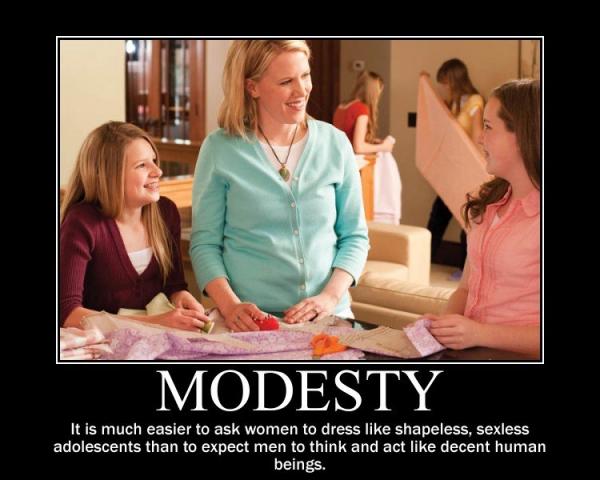
There are two parts to this point, I think. Firstly, freedom does not mean debauchery. Fashions and trends that came, quite literally, from the brothels, have their roots in an erotic desire to seduce. Whether or not that is your intention, if you dress like a slut, no matter how modest your
behaviour or how respectful your male friends/fathers/brothers etc, the underlying principle behind fishnets, miniskirts, midriff T's, and plunging V's is to reveal the sexual. For a generation fixated (pun intended) on Freud, we seem reluctant to acknowledge that human sexual desire is often rooted in the subconscious, and often triggered without our intent. So in this sense, my answer to Mr. Murray is that I would not want a man to walk around in nothing but a thong, either. For me, modesty is not an issue of gender, it's an issue of human dignity, and of not revealing that which does not need to be revealed.
Secondly, again allowing for the minority of ignorant bigots in the world, I must say that I have never met a thinking, reasonable individual, no matter what their faith background or upbringing, who would look at a rape victim and be insensitive to her wounds because the pervert who hurt them was triggered by their (lack of) clothes. Rape happens to the fully clothed and to the scantily clad. While I would no more ask a pedophile to babysit my child than tempt a rapist by wearing a see-through shirt and booty shorts, nobody with reason and charity is going to write off a rape victim because of how she was dressed. Are there people who do? Most certainly. Do I count them among people who are a. reasonable, b. kind, or c. my friends? Absolutely not. There is no excuse for bitter ignorance, no matter which side it's coming from.
[By the way, to play devil's advocate, if I exercise my 'right' to violate a man's eyes, mind, and desire by walking around half naked (because I think it's a tenet of history that men are generally aroused by naked women), why isn't it ok that he exercises a similarly constructed 'right' to violate
my body?]
On a surface level, men don't (generally) walk around in immodest clothes because there just isn't the market for it. The female body, let's face it, is way more beautiful and interesting than the male body, so seductive clothes primarily come in the girly sizes and styles. If men
did walk around in immodest clothes, I'd call them out too. Let me reiterate what I said a few lines earlier: this isn't an issue of gender, it's an issue of human dignity.
3. Because of feminism, there are no major Christian conferences about how
to act like men, where thousands of men can celebrate their manliness
and Jesus (and perhaps poke fun at female stereotypes).
There seems to be a double-standard here. On the one hand, feminists don't want to be forced into the Christian stereotype of 'feminity' that defines them as mothers, wives, and the complimentary sex to men's manliness. On the other hand, they gripe because there aren't any conferences in Christian spheres about how to be 'Christian-ly' a woman? Which is it? Or is the real complaint here that Christianity supports a womanly-feminism that highlights and adulates motherhood and a very gendered womanhood that flies in the face of the contraceptive, asexual, pants-suit-wearing, feminism that vociferously demands utter and total equality with men? Sorry, ladies (or is 'ladies' too offensive a term?). Christianity endorses authentic womanhood, based on God's specific gifts to women. Just because they don't pander to perspectives that are not part of their particular creed doesn't make them discriminatory. By your logic, do you also expect PETA to have a branch of its organization that raises cows for slaughter just to represent the portion of the population that eats meat--even at the expense of its values?
On a smaller note, I also don't think that the claim that there are no large-scale church groups that serve women is true--at least in the Catholic Church we have lots of women's organizations, from the CCW to CRHP to Regnum Christi that have specific branches for men and for women, which include gender as part of their specialized approach to whatever the topic of the retreat or meeting is. I personally go on retreats and have been involved in groups that are tailored for women, or for young adults, etc etc. If there is one major organization that has gotten 'special interest group' ministry-making down to an art, its the Catholic/Christian churches.
4. Because of feminism, church stages and spotlights are often dominated by
women. Men are encouraged to just serve in the nursery or kitchen.
Sometimes men are even told to stay silent in church.
This point is closely tied to the preceding. I recently had a discussion with a friend of mine from school about this very thing: she feels that women are underrepresented in Christian churches, and that the roles they are given are discriminatory (i.e., women are discouraged from being pastors, and are, as the article says, asked to 'serve in the nursery or kitchen'.)
This is far too big a topic to take on in this post, for the sake of length, but let me say this: Clinical psychology as well as many hard sciences posit that the male and female brain function differently. One is not better or worse than the other, but, as
this article (just as one example) says, "Women tend to be intuitive global thinkers. They consider multiple sources of information within a process that can be described as simultaneous, global in perspective and will view elements in the task in terms of their interconnectedness" while Men "tend to focus on one problem at a time or a limited number of problems at a time. They have an enhanced ability to separate themselves from problems and minimize the complexity that may exist". In other words, on many levels, men and women have different strengths and approaches to problems. This naturally and logically makes each gender
better suited for certain types of jobs. Does this mean no women can be a CEO? No. Does this mean no man can raise a child? No. What it means is, play to your strengths.
In a Christian worldview, where the sexes use their strengths in a way that combines their attributes to make a solid, unified and almost in-conquerable whole, there are 'traditional' roles given to each gender that is intended to make the most of their gifts. Being asked to run the nursery is not a statement of a woman's inadequacy to preach; it is an attempt to utilize her ability as an organizer, nurturer, and global problem solver. Furthermore, in a worldview that also sees children and the future generations of Christians as important, beautiful gifts to be nurtured and strengthened so they can succeed in life and attain salvation, a woman's job is arguably the
most important. I am boggled by the feminist argument that motherhood is somehow a lesser or 'simple' job, lacking in value, or the leftover job in a man's world. Female roles are absolutely integral to the functioning and continuation of the human race, especially if we want a future generation that progresses and gravitates towards peace. Meanwhile, men's ability to hone in on one point and think of the group as a unit (where women focus on the group with special attention to individuals' needs) makes them more suited for conventional 'leadership' roles. This is not a social commentary on male/female
ability. It's just a factual, scientific reality of what they're each better at. You don't hear people lobbying for us to use dogs for transportation and horses for a guide-animal for the blind. Each has its own strengths, and each performs
best when allowed to draw on that strength.
5. Because of feminism, women make more money than man in the same jobs.
The glass ceiling? Really? Last I checked we aren't in 1980 anymore. Where/If there are places where women are making less, it isn't because they're women. It's because they either aren't as good at the job as a parallel male in the same job, or because they are newer. If I complained that I didn't make as much as my boss on the grounds of discrimination since he's a man and I'm a woman, you'd laugh. I'm a receptionist. He's a business owner. Please show me one REAL example of widespread salary differentials that are
not so vague as to ignore the specifics of each situation. It's all well to show a chart that seems to show that female football players make less than male football players...but...wait. I'll just let you finish that one for yourself. I really just don't have the time of day for that glass ceiling garbage anymore.
6. Because of feminism, it's hard to find a movie with a heroic male lead
anymore. Most blockbusters feature a brave woman who saves the world and
gets a token man as a trophy for her accomplishments.
I read an article recently (unfortunately I can't remember the name) about this very thing. It frustrated me, because it was contingent on yet another double-standard. First, it complained that there weren't enough strong female leads. Then, it complained that there were too many strong female leads that were the wrong
kind of strong female lead, because all they were doing was saving the world. What exactly does a strong female lead who is not doing male things, but is also not stereotypically 'feminine' look like? Mystique from X-Men, maybe? I really don't know what proponents of feminism want to see in cinema. If Angelina Jolie plays a feminine role, she's a trophy wife, or the token female character that permits directors to include a sex scene. If she's Tomb Raider, she's just a woman given a man's strong lead.
What do you want? I'll give you a movie with a strong female lead:
The Passion of the Christ. But that isn't what you're asking for, is it? That features a woman who embraces her feminine qualities utterly and perfectly, and ends up Co-Redemptrix of the entire human race for all eternity as a result. Yeah, you're right. That's much too weak.
7. Because of feminism, women's professional sports are a massively
profitable enterprise where women are globally idolized. Men only appear
briefly, before commercial breaks, when they're objectified for their
bodies.
.....Swimming. Soccer. Hockey. Lacrosse. Diving. Volleyball (no, not the kind where they wear bikinis). Tennis. Golf. Basketball. Equestrian events. Softball. Please, explain to me again how women are being reduced to breasts and reproductive organs in the sports world?
(I'm not saying women aren't objectified in our culture in many contexts, but please, Mr. Murray, at least try to use somewhat-real examples.)
8. Because of feminism, all birth control is covered for women without question or debate, while men have to fight to get insurance
companies to pay for their Viagra prescriptions. When men do speak up
about this, leaders of the "family friendly" right wing labels them
"sluts" and "whores."
Because of feminism, United States citizens are being forced to pay for birth control and abortion on demand with their taxpayer dollars and insurance policies. So firstly, this statement is just untrue. Secondly, the wonderful world (heavy sarcasm) of Planned Parenthood etc make birth control readily and cheaply available. Plus, last I checked, Viagra is not a form of male birth control. :-p Thirdly, proclaiming to the world that you want an active sex life, free of charge, and with no natural consequences, does at least make you a hedonist. While it's wrong to call someone a 'slut' or judge their character, a person who believes in the sanctity of marriage and the unique and exclusive role of sex within marriage does indeed have the right--and the moral obligation--to call you out on your promiscuous
behaviour.
Yup. Totally articulate and classy.
9. Because of feminism, the male body is constantly under public scrutiny.
If a man appears topless on TV, it's a national scandal resulting in
huge fines and boycotts. Bloggers regularly write about how we need to
be more mindful of the ways our clothing choices tempt women to sin.
Satirists insist that shorts "aren't really pants" and then men should
cover up because "nobody wants to see that."
This is almost a reiteration of #2. There's little to say to add to what I have already said about modesty and human dignity except to reemphasize that if men were walking around with no pants on, I'd have a problem with that too. The fact that women have more sexual parts and more sexually and physically beautiful bodies hardly makes it discrimination to ask them not to put it all out there for everyone to see. Just because you have no respect for your body doesn't mean society shouldn't. If a man was publicly exposing his 'junk', he'd get arrested. Equal rights and equal treatment, remember?
10. Because of feminism, men are not represented in the White House, and
women hold over 80 percent of the seats in Congress. When a man runs for
office, his physical appearance and clothing choices are discussed
almost as much as his policies and ideas.
I've heard this argument many times, and it always amuses me. Hilary Clinton ran for president. She performed well in the debates. And she lost, through due process and fair voting. Now, while I would argue that political leadership is a role better
suited to men, that is my personal opinion, and I don't believe it has anything to do with why there aren't more women in government. I think there are fewer women in government because there are fewer running or interested in running for election. Maybe I'm wrong. But women have the vote, and so women have representation, correct? I fail to see where the discrimination lies, if a disparity exists at all.
11. Because of feminism, men must fight for a voice in the public sphere. In
issues of theology, politics, science, and philosophy, the female
perspective is often considered default, normal, and unbiased. Male
perspectives are dismissed for being too subjective or too emotional.
When we speak up, we are often dismissed as angry, rebellious,
subversive, or dangerous.
Watch TV. Just regular TV. 75% of commercials feature a woman telling us about a product while a man makes the mess that requires her to
use the product. The man can't fix his computer; his wife calls PCMatic for him. A man left alone with his messy toddler asks 'Where is your mother?'.
Look at hot button social issues like abortion. Who has gotten the law passed that 'they' called for (I'd argue that the group of women that wants abortion on demand is not representative of the whole) in regards to an issue like that? I'm sorry, Mr. Murray, but women have a voice, often to the detriment of this country. As a woman, I hold my gender highly accountable for the destruction of moral culture and the family in the United States. Not solely responsible, but certainly heavily involved. Whether or not there exists a stereotype of women as a more emotional sex does not have any weight whatsoever on whether or not they have a voice, anymore than the stereotype of men being better drivers impacts the number of male drivers who get in accidents. Stereotypes don't define reality, thankfully. Look at all of the feminist 'issues' that have come to influence the way we live. Women do have a voice, and I would go so far as to question how that voice is being used.
Murray closes the article by saying this:
Whatever you do, don't read Jesus Feminist.
It's full of ideas that will continue to oppress and harm men -- ideas
such as "women are people too" and "the dignity of and rights of women
are as important as those of men".
The attitude here is that we live our lives as though women aren't people, and as though their dignity doesn't matter. I could write a whole new post on this point alone. But I'll try to be succint.
First, we abort girls. So in that sense, yes, women in the womb are discriminated against, especially in countries like China. Just do a google serach on 'sex-selective abortion'.
Second, and I can't stress this enough,
how dare American women put themselves in the same category as Jews, Blacks, Christians, and other groups that have been
killed for being who they are? American women, who have all the rights and freedoms that being an American citizen entails--and who have even more privileges touted as 'rights' that they
shouldn't have (like abortion and contraception)--and then look into the eyes of Anne Frank, or Rosa Parks. Excuse me, but I don't think you (modern feminists) know what discrimination is. I don't think you understand what it means to have society as a whole refuse to acknowledge your
personhood.
The sickening irony of women, who have no idea what discrimination is, clamoring for 'acknowledgement of human dignity' while in the same breath advocating for the 'right' to end the life of their child is mind-boggling.
I was talking to my boyfriend about this a little bit ago and he also noted that if there are places in the world where the oppression of women exists, it surely isn't here. Visit Africa, South America, China, or a Muslim country, and ask the women there if American women are 'oppressed'. The arrogance and utter selfishness of such claims is just...unspeakably disgusting. I am ashamed, as a woman, that such lies are being told in the name of my gender.
As I said, I could post at length about just this part of the article. But I need to bring it full circle instead. The title of the article is "How Feminism Hurts Men", and the whole purpose of it is to suggest that feminism doesn't hurt men, and in fact, men hurt women and women's rights. I take issue with your very premise, Mr. Murray. Feminism
does hurt men.
Feminism suggests that men should be ashamed of their masculinity. And don't tell me this isn't true. This isn't an issue of 'Men are fine as they are, we just want some of the same opportunities'. The very root of feminism says "Step aside, men, and let women be in charge". But this is disordered. Men are, as I have at least hinted, suited for leadership. They are physically, mentally, and emotionally suited for being providers and protecting the safety and well-being of their family or a business etc. Again (and I feel I must stress this repeatedly or someone will ignore everything preceding and accuse me of delusions), women are certainly
capable of doing these things. But they are not innately made for it. So to ask a man to stop being a man--to let a woman do the things he was made to do--renders him useless.
Furthermore, as women encroach further and further into the spheres of life that were originally the purview of men, men become ashamed to participate in them. It's the same kind of dynamic at work in the feminist mind, except reversed and subjugated. Feminists aggressively express irritation at male involvement in work spaces and leadership roles; men find a hostile, antithetical female usurpation at work in pursuits that define their very purpose. Do you wonder why we have a growing divorce rate, fatherless families leaving single mothers to fend for themselves, and disrespectful, bestial men seemingly driven solely by sexual desires? Obviously, feminism is not all to blame. But it plays a huge role.
Men no longer want to be men, or feel that this occupation--manhood--is no longer theirs. When men must share manhood with women, they become disenfranchised wanderers. Why work hard, why strive to be a gentleman or a moral creature, when you have no purpose? This sounds melodramatic, but take a long hard look at a man who is, to use the colloquial term, 'whipped'. Think of the sexless marriages, which fall apart and end in unfaithfulness and bitterness because the wife, emboldened by what feminism tells her is her 'right' to power and equal standing with her husband, witholds herself from him as a strategy of revenge and abuse.
Women are oppressed? Today's
men are abused, cruelly. The feminist idea of gaining 'equality' for women has resulted in a total reversal of the kinds of thinking (equally wrong) that applied to women in the antebellum South or the Victorian age. Then, women were mistakenly assumed to be stupid, weak, and to be used as a kind of currency or adornment. Today, men are automatically presented as stupid, monochrome beasts who have no capacity for any endeavor of worth, and serve only to bolster the ego of the women in their lives.
So in closing, Mr. Murray, and feminists, I say, look in the mirror. The chimera that you were battling when this all began, the monolithic enterprise that you called 'man' that you claimed was so oppressing you, that you wanted equality with? You are it. You have succeeded. You have gained such equal footing with the mythical creature you were fighting against that you have transformed into it.
You are the oppressors now, and you are destroying social order. So don't you dare, Mr. Murray, satirize the demise of the family, of functional marriage, of complimentary and harmonious gender roles. Don't try to ironically champion the perverted movement that has inverted our society. What's sad is that you're a victim of the very ideal you're pushing. The more deeply ingrained in society feminism is, the more you lose, Mr. Murray.
Oh, and PS, Mr. Murray: Christianity, you know that oppressive patriarchal institution that peppered your article with oppression? It's founded on a God-made-Man who chose before all time to be born of a
Woman.
I'll close with this thought from Pope John Paul II, who spoke so eloquently on gender and human dignity:
"Womanhood expresses the "human" as much as manhood does, but in a different and complementary way...When the Book of Genesis speaks of "help", it is not referring merely to acting, but also tobeing. Womanhood and manhood are complementary not only from the physical and psychological points of view, but also from the ontological. It is only through the duality of the "masculine" and the "feminine" that the "human" finds full realization....
...The Church sees in Mary the highest expression of the "feminine genius" and she finds in her a source of constant inspiration. Mary called herself the "handmaid of the Lord" (Lk 1:38). Through obedience to the Word of God she accepted her lofty yet not easy vocation as wife and mother in the family of Nazareth. Putting herself at God's service, she also put herself at the service of others: a service of love. Precisely through this service Mary was able to experience in her life a mysterious, but authentic "reign". It is not by chance that she is invoked as "Queen of heaven and earth". The entire community of believers thus invokes her; many nations and peoples call upon her as their "Queen". For her, "to reign" is to serve! Her service is "to reign"!"
For the full text of JPII's Letter to Women (it isn't a long read, and is so worth it--and I think liberal women will be surprised how much they find in it to agree with), go
here.
For more reading on what is known as 'New Feminism', check out
this excellent article, which incorporates much of JPII's beautiful explanation of femininity and the complimentary of the sexes.